

There’s a version of thyroid trouble nobody feels sorry for you about, because from the outside it looks like productivity. You’re fast. You’re getting it all done. And at two in the morning you’re lying awake with your heart going like you ran up stairs, hot in a room where everyone else is comfortable, hungry all the time and losing weight anyway, unable to remember the last time your body idled. An overactive thyroid is your metabolic thermostat jammed high, and the old body-wisdom traditions have a blunt question about it: what convinced this body that it was running out of time?
If you haven’t read the overview of thyroid patterns yet, that’s the wider map, four thyroid patterns and the buried stories under each. This is the deep-dive on the fast one: hyperthyroidism, and Graves’ disease, its autoimmune form.
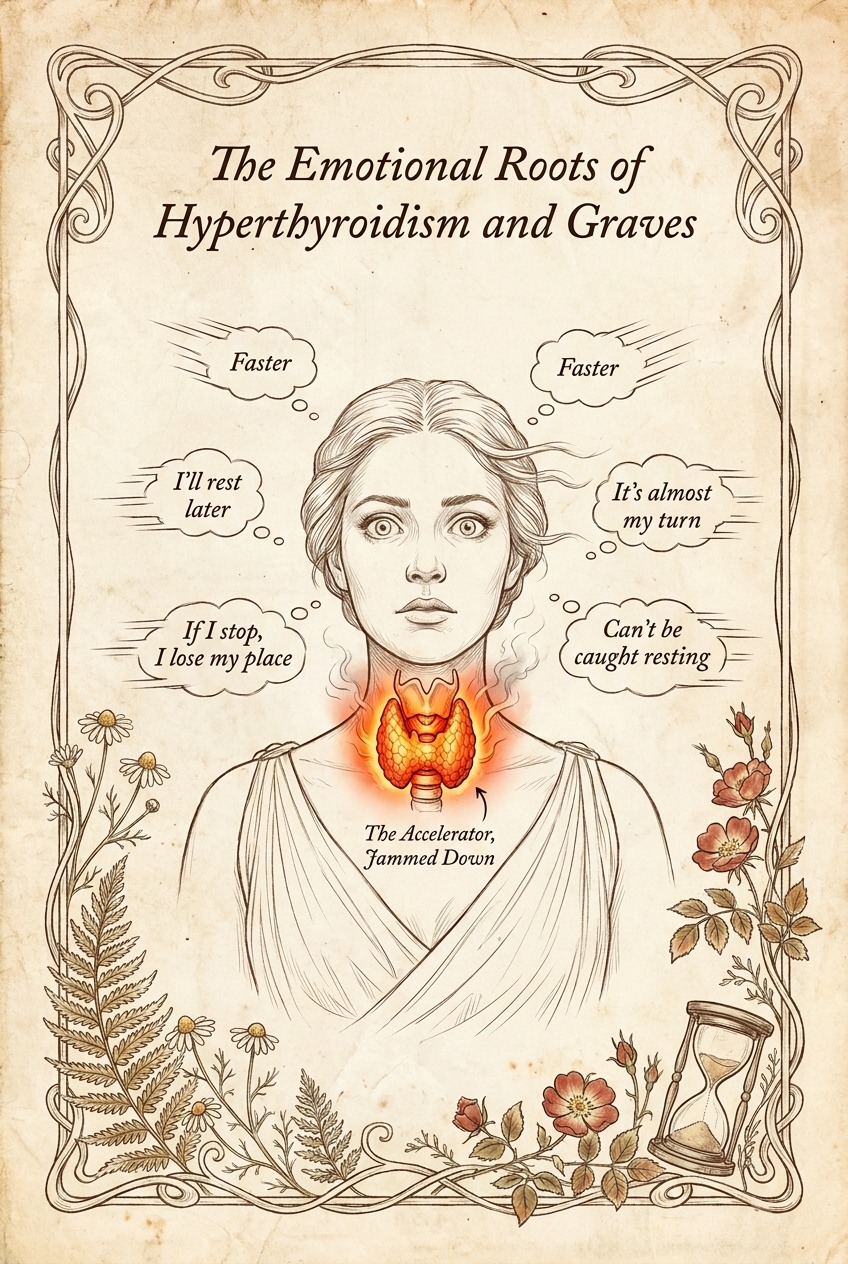
The person this tends to be
They’ve been running for years, and not for the joy of it.
Somewhere back there is a left-out place. A family where attention went to somebody else. A season where their needs got skipped so routinely that they stopped filing requests. Louise Hay’s entry for the overactive thyroid is stark, rage at being left out, and the German New Medicine tradition, which maps the thyroid to time, frames the fast side as its own specific panic: I can’t catch the piece fast enough. Not the brake of the underactive pattern, the life stuck waiting. The opposite. The grab. The conviction that a turn only comes to the person who’s sprinting when it opens, and that stopping, even briefly, means losing your place in a line you fought to be in at all.
So they over-function. They’re the one who says yes before the sentence is finished, who fills every silence with usefulness, who treats rest the way other people treat risk. The speed passes for ambition, and some of it is. But underneath the ambition is the older arithmetic: if I stop, I disappear. People who were reliably included don’t run like this. This is the pace of somebody who learned that their share of things, attention, love, time, a turn, wasn’t going to be held for them.
And the body keeps that pace. The gland that sets your metabolic speed does exactly what it’s told, and what it’s being told, all day, every day, is faster, we’re behind, it’s almost our turn.
Not everyone with an overactive thyroid is this person. But if your chest just tightened in recognition, keep reading.
Where Graves’ fits
Graves’ disease is the autoimmune version: the immune system stimulates the thyroid into overdrive. And the autoimmune piece matters here, because the traditions, Henry Wright’s autoimmune framework most directly, understand autoimmunity, the body acting against its own tissue, as the somatic echo of a self turned against itself. In the Hashimoto’s post that self-directed pattern shows up as shutdown. In Graves’ it shows up as agitation, the self-attack expressed at speed. The inner critic doesn’t slow this person down. It drives. It’s the voice on the treadmill saying you’re behind, and the immune system, in a strange loyalty to the message, leans on the accelerator too.
If you have Graves’, both stories are probably yours: the left-out rage of this post and the self-turned-against-itself pattern of the Hashimoto’s one. Read both. The one that lands harder is your starting point.
What it feels like from the inside
Many people who live at this speed describe it in nearly the same handful of sentences:
- I don’t know how to rest. Even on vacation I’m doing.
- If I slow down, everything I’ve built my place on falls apart.
- I’m angry and I don’t know where to put it, so I put it in motion.
- I feel like I’m racing something and I can’t tell you what.
- When is it going to be my turn?
That last one again. It runs under the slow thyroid as a resignation and under the fast one as a sprint, but it’s the same sentence, and it turns up verbatim in unrelated traditions. The underactive pattern gave up on the turn. This pattern is trying to outrun the doubt.
What the speed might be saying
If the pattern could put itself into words, I think they’d be these:
You told me we were about to miss it. Whatever it is, the turn, the chance, the place at the table, you’ve been telling me for years that it’s almost here and we can’t be caught resting. So I stopped resting. I’m burning everything we have to keep you fast enough to grab it. If you want me to come down off this pace, you’ll have to show me the thing I’ve been protecting you from: that you can stop, and still be included. That your place doesn’t vanish when you sit down.
Seen that way, an overactive thyroid isn’t a body malfunctioning. It’s a body over-cooperating with an emergency that was declared a long time ago and never called off.
This particular pattern can get medically serious in ways the slow one usually doesn’t. An overactive thyroid needs active management by someone qualified; this page is about the level underneath that work.
If this isn’t you
Real information, not a failure of the idea. Quick routing:
- If you’re slow, cold, tired, and heavy rather than racing, you’re on the other pedal: the hypothyroid post covers the brake, including the diet-culture downshift almost nobody names.
- A diagnosis of Hashimoto’s means the self-attacking pattern has its own full post.
- If the thing you notice is a lump or a swelling in the throat, that’s nodules and goiter, the swallowed thing made visible.
- And if your anger has a clear address, a specific person, an unfair hand, and lives as bitterness rather than speed, that’s a different door than this one: Willow is the essence for the grudge and the victim story, and the nodules post walks that territory.
What actually slows the sprint
Not a lecture about self-care. You’ve heard it, you’ve probably given it, and this pattern eats “balance” advice for fuel, one more thing to be behind on. What moves it is different in kind:
- Sit out one thing you’d normally sprint for, and watch what happens to your place. Small stakes first. The pattern’s core prediction is that stopping costs you your spot. The only argument it respects is evidence.
- Find the anger and give it an address. Rage at being left out is real anger, and motion is where you’ve been hiding it. Name who left you out. Say it somewhere, to a person, to a page, out loud in the car. Anger that’s finally pointed at its actual target stops needing your metabolism as an outlet.
- Let a silence go unfilled. The over-functioning reflex treats every gap as an audition. Declining one audition a day is training, and it counts even when it’s uncomfortable. Especially then.
- Grieve the being-left-out instead of outrunning it. Underneath the rage is the original wound, the attention that went elsewhere, the needs that got skipped. Sprinting keeps it behind you. It also keeps it unhealed.
Where flower essences come in
Flower essences work on the emotional side of this, the left-out rage, the can’t-stop reflex, the pace that’s really a fear. They aren’t a treatment for hyperthyroidism or Graves’; what they keep company with is the pattern underneath.
For the pace itself, Stress-Less is the blend that wraps up most of this post. It’s made for the ones who habitually cram too much into too little time, and it works toward releasing the activity that doesn’t matter so there’s room for what does, at a pace you can actually sustain. It carries Pussy Willow for the all-doing-no-being strain that turns a person rigid before it cracks them, Speedwell for moving at the right speed and the radical idea that you’re allowed to rest, and three more allies for the racing mind underneath.
And for the rage that has nowhere to go, Anger Management is the blend, brisk name notwithstanding: it’s built for the release of rage, repressed anger, and resentment, the whole fuel depot this pattern runs on, along with the jaw tension of holding it all in. If a single flower is more your speed, Impatiens is for the hurried, irritable edge, the state where everyone around you is moving infuriatingly slowly, which is usually a sign that you’re the one moving wrong.
Pick the one that fits. If it’s the pace, start with Stress-Less. If it’s the rage, Anger Management.
For members who go deeper, there’s a bioessence in the Secret Stash built around this same emotional-roots-of-the-throat territory, combining flower essences with hertz frequencies. It’s a members-only formulation, and it stays behind that door on purpose. If that’s a door you want open, that’s what the Vital Essence Association is.
Flower essences are not evaluated by the FDA and are not intended to diagnose, treat, cure, or prevent any disease. Nothing here is medical advice or a substitute for the care of your doctor.
What to do with this
If something in you went still while you read, probably at the left-out place, that’s your thread. The work isn’t to run faster at healing it. That would be the pattern again, wearing a wellness outfit. Start with one sat-out sprint and one named anger, and bring an essence alongside if you want the company, Stress-Less for the pace or Anger Management for the fuel. If you can’t tell where to begin, a Custom Combo lets a practitioner build to your exact pattern instead of you guessing.
Your body has been running an emergency drill for years on your instructions. It’ll believe the all-clear the same way it believed the alarm: from what you do. The wider map is in the overview, and the siblings of this post cover Hashimoto’s, hypothyroid, and nodules and goiter.
Frequently Asked Questions
Does this apply to Graves’ disease?
Yes. Graves’ is the autoimmune form of an overactive thyroid, so both this post’s left-out-rage pattern and the self-turned-against-itself pattern in the Hashimoto’s post usually apply. Read both and start with the one that lands harder.
Can I use an essence alongside my thyroid medication?
Essences work on the emotional and energetic level, so people commonly use them alongside their lives. But an overactive thyroid needs active medical management, and anything involving your medication or your diagnosis is your provider’s call. Keep your plan; the essence is for the pattern underneath.
Isn’t being driven just my personality?
Some of it probably is. The difference worth noticing is that drive that can rest is ambition, and drive that can’t stop is usually protecting something. If sitting out one small thing feels like risking your place, that’s the pattern talking, not your personality.
Where do I actually start?
Sit out one thing you’d normally sprint for and watch what happens to your place, and give the anger an actual address instead of an outlet. If you want an essence alongside that, Stress-Less is built for the pace and Anger Management for the rage; if you can’t tell which, a Custom Combo lets a practitioner build to you.
How long does this take?
Longer than a bottle. The body believed the emergency for years, and it’ll believe the all-clear the same way, from evidence. Each sprint you sit out without losing your place is one piece of it.
0 comments