

Most thyroid trouble is invisible. This kind isn’t. A nodule shows up on an ultrasound, or under your fingers, or in the mirror as a fullness at the base of your throat that wasn’t there before. A goiter announces itself. And of all the shapes the thyroid takes, this is the one where the old body-wisdom traditions barely have to reach for their interpretation, because the symbolism is sitting right on the surface: a lump, in the throat, in the exact place where the unsaid things go.
Everyone knows the feeling of a lump in the throat. It’s what a swallowed sentence feels like on its way down, the grief you didn’t let out at the funeral, the answer you didn’t give in the meeting, the thing you’ve been not-saying to your mother for twenty years. The traditions look at nodules and goiter and see that same event with a longer timeline: the throat thickening, physically, around decades of things that needed to come out and were sent back down instead.
If you haven’t read the overview of thyroid patterns yet, that’s the wider map, four thyroid patterns and the buried stories under each. This is the deep-dive on the structural one: the swallowed thing made visible.
Nodules are common, the great majority are benign, and every one of them belongs in front of your doctor. Nothing on this page is a substitute for that. This page is about the other level, the one the ultrasound can’t see.
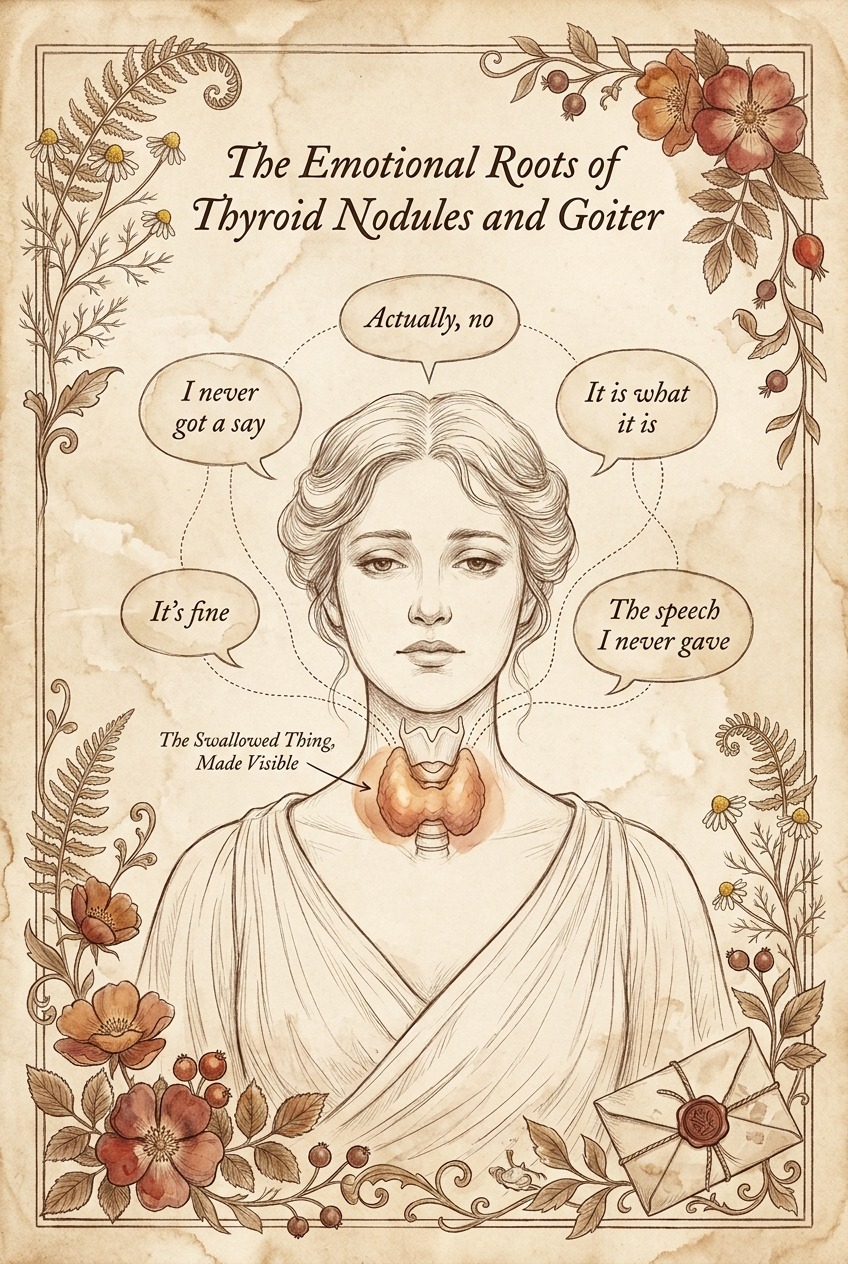
The two things that got swallowed
The traditions that map this pattern name two different kinds of swallowed material, and it’s worth telling them apart, because they point at different work.
The first is words. The German New Medicine tradition is blunt about the organs of the throat: all trouble in this territory has to do with the fear of saying something. There’s a message that needs to pass, and it doesn’t pass. Year after year, the same sentence rises and gets sent back down. The rehearsed speech that never gets delivered. The true answer replaced, one more time, with “it’s fine.” In this view, the throat doesn’t just carry the unsaid words, it eventually starts to hold their shape.
The second is grievance. Louise Hay’s entry for goiter is one of her sharpest: hatred for being inflicted upon. Feeling victimized, thwarted, done-to. Life happened at you, and your say in the matter got overridden, and the protest you were owed never got lodged anywhere. That’s a different kind of swallowing than shyness. It’s the injustice you never got to file. And that entry suggests it doesn’t dissolve just because you were forced to accept the situation. It accumulates, and it accumulates here.
The two usually braid together. The person who feels most inflicted-upon is very often the person who was never allowed to object out loud. The words and the grievance go down the same one-inch channel, and they land in the same place.
The person this tends to be
They’re the one things happened to.
The move they didn’t choose. A role in the family, assigned before they could weigh in. Years rearranged around somebody else’s illness, career, temper, needs. When they tell their story, if they ever get to, the sentences have a shape: and then I had to, and then it fell to me, and then that was decided. Somewhere in there they learned that objecting was pointless or dangerous or both, so the objections stopped making it past their throat. Not because the objections weren’t there. Because filing them cost too much.
Ask if they’re angry and they’ll probably say no, and mean it. What they’ll cop to is tired, or thwarted, or a phrase like “it is what it is,” said in the voice of someone for whom it very much is not fine that it is what it is. The protest is all still in there. It just stopped applying for permission to come out, and started accumulating instead.
Not everyone with a nodule or a goiter is this person. But if your throat did that little clench of recognition while you read, keep going.
What it feels like from the inside
Many people who carry this pattern describe it in language that keeps circling the same drain:
- I never got a say in the things that shaped my life.
- There’s a whole speech in me that’s been ready for years.
- I swallowed it. That’s the exact word for what I did. I swallowed it.
- It is what it is. (Said the way you’d say a door is locked.)
- I can feel it right here. (And they touch the base of their throat.)
If one of those is yours, notice that the language itself keeps choosing the throat. People say I swallowed it about grievance and lump in my throat about grief without anyone teaching them to. The traditions didn’t invent the connection between this territory and this gland. They just took the figure of speech seriously.
What the lump might be saying
If the pattern could put itself into words, I think they’d be these:
You kept sending them down, so I kept them. Every objection you were owed and never filed, every speech that was finished and never delivered, every “actually, no” that turned into “it’s fine” on its way out. You needed them to go somewhere, and this is where they went. I’m not hiding them anymore. I’ve put them where you can feel them, right at the door they never got to walk through. You can’t take back what you already sent me. But you can stop sending. Start letting things leave by the front.
Seen that way, the visibility is the message. Every other thyroid pattern works in secret and shows up in lab work. This one shows up where you can see it, at exactly the gate the unsaid things were stopped at.
If this isn’t you
Real information, not a failure of the idea. Quick routing:
- If there’s no lump and the picture is slow, cold, tired, heavy, that’s the brake: the hypothyroid post, including the diet-culture downshift almost nobody names.
- Racing, wired, hot, can’t rest is the accelerator: the hyperthyroid and Graves’ post.
- If your diagnosis is Hashimoto’s, the self-attacking pattern has its own full post.
- And if what you found while reading is anger pointed at yourself rather than at what was inflicted on you, the Hashimoto’s post is the closer fit even without the diagnosis, because that’s the inward-turned version of this same anger.
What lets the backlog out
The instinct, once you see the pattern, is to want one giant reckoning, the confrontation that finally files every grievance at once. That’s usually neither possible nor kind to anyone, including you. What moves this pattern is smaller and more regular than that:
- Deliver one small true thing to its actual address. Not the twenty-year speech. One sentence, to the person it belongs to, while it’s still warm. The pattern was built out of sentences that aged into impossibility. The countermove is sentences that don’t get the chance to age.
- Write the speech you’ll never give, and give it anywhere. Some of the backlog is owed to people who are gone, or dangerous, or incapable of hearing it. It still needs to leave through the front door. A page, an empty room, a long drive. The file gets to close even when the person never reads it.
- Say what you’d have chosen, out loud, even now. “I didn’t want to move.” “I’d have said no to that.” Naming the overridden choice, years later, sounds pointless and isn’t. It’s the objection finally getting filed, and the filing is for you, not for the record.
- Let “it is what it is” retire. That sentence is a swallow dressed up as acceptance. Real acceptance can say what it lost. When you catch yourself reaching for it, try the longer version: what it is, and what you’d have wanted instead. Both halves out loud.
Where flower essences come in
Flower essences work on the emotional side of this, the stuck words, the swallowed grievance, the objections that never got filed. They aren’t a treatment for nodules or goiter. What they keep company with is the backlog.
For the grievance half, two point most directly at it. Willow is the essence for exactly what Hay’s entry names: the bitterness and resentment of being dealt an unfair hand, the grudges, the victim story that formed because for a long stretch you genuinely were on the receiving end. It works toward letting that go, not by calling it fine, but by putting it down. And Anger Management, the blend, is built for the release of repressed anger and resentment, including the jaw tension of decades of holding it in.
For the words themselves, Speak Freely is the blend built for this whole territory: for the ones who go quiet to keep the peace, who bite back their truth, who freeze or over-explain when it’s finally time to say what they want. It carries Blackberry for the truth that sits in your throat, Snapdragon for the set jaw and the bitten-back sentence, Trumpet Vine for the words that get stuck on the way out, and three more allies for saying hard things in a way that connects instead of divides.
And Plantain sits at the seam between the two halves, releasing bitterness while turning biting words into something you can actually deliver.
Pick the one that matches your half of the pattern, the grievance or the words. If you can’t tell which half is yours, that’s worth knowing too: they braid.
For members who go deeper, there’s a bioessence in the Secret Stash built around this same reclaim-your-voice, emotional-roots-of-the-throat territory, combining flower essences with hertz frequencies. It’s a members-only formulation, and it stays behind that door on purpose. If that’s a door you want open, that’s what the Vital Essence Association is.
Flower essences are not evaluated by the FDA and are not intended to diagnose, treat, cure, or prevent any disease. Nothing here is medical advice or a substitute for the care of your doctor.
What to do with this
Start on the half that’s yours: one small true thing, delivered to its address, this week. If the grievance half of the pattern is what clenched while you read, Willow is where I’d start. If it’s the words, Speak Freely. And if the whole page landed at once, a Custom Combo lets a practitioner build to your exact pattern instead of you guessing.
Your body filed the backlog where you’d finally have to notice it. The wider map of the thyroid’s patterns is in the overview, and the siblings of this post cover Hashimoto’s, hypothyroid, and hyperthyroid and Graves’.
Frequently Asked Questions
Do I still need the ultrasound and the doctor?
Yes, first and always. Nodules are common and the great majority are benign, but every one of them belongs in front of your doctor for the physical evaluation. This post is about the other level, the one the ultrasound can’t see.
Are you saying my nodule was caused by not speaking up?
No. The old traditions notice that this territory and swallowed words keep company, and the language people use, a lump in my throat, I swallowed it, keeps choosing the same spot. That’s a pattern worth taking seriously, not a diagnosis, and the emotional work is worth doing on its own terms either way.
What if I can never say the thing to the person it belongs to?
Some of the backlog is owed to people who are gone, or dangerous, or incapable of hearing it. It still gets to leave through the front door: write the speech and deliver it to a page, an empty room, a long drive. The file closes even when the person never reads it.
Which essence do I start with?
It depends on your half of the pattern. If it’s the grievance, the being done-to that never got its protest filed, start with Willow. If it’s the words themselves, Speak Freely is the blend built for the whole territory. If they braid and you can’t tell, a Custom Combo lets a practitioner sort it with you.
Can I take an essence alongside whatever my doctor prescribes?
Essences work on the emotional and energetic level, so people commonly use them alongside their lives. Anything involving your diagnosis, monitoring, or medication stays your provider’s call. Keep the appointments; the essence is for the backlog underneath.
0 comments