

Your gut has exactly one job, and it’s a job your emotions borrow constantly: take life in, keep what nourishes you, and let the rest move through and out. That’s the whole assignment. Absorb the good, release the finished, repeat.
So when your intestines stop doing that job, it’s worth asking what else in your life stopped doing it too.
Every tradition that maps the body this way lands on the same square when it gets to the gut, which almost never happens. Louise Hay calls constipation “refusing to release old ideas, stuck in the past.” Chinese medicine files the large intestine under the element of letting go, and its emotion is grief, the grief you haven’t finished putting down. The body-decoding folks see a stalled digestive tract as holding on out of a fear that there won’t be enough, so you keep everything, physically and otherwise. The spiritual-roots teachers call it gripping instead of trusting.
Different vocabularies, one sentence underneath all of them: you cannot digest what you refuse to let move through you.
That’s the part that lands for almost everyone, because almost everyone with a stalled or reactive gut recognizes some version of “I’m holding on,” “I can’t process this,” “I can’t let it go,” or “I don’t feel safe letting go.” If that’s you, you’re already in the right post. The next question is just which flavor of it is yours.
A note before you scroll
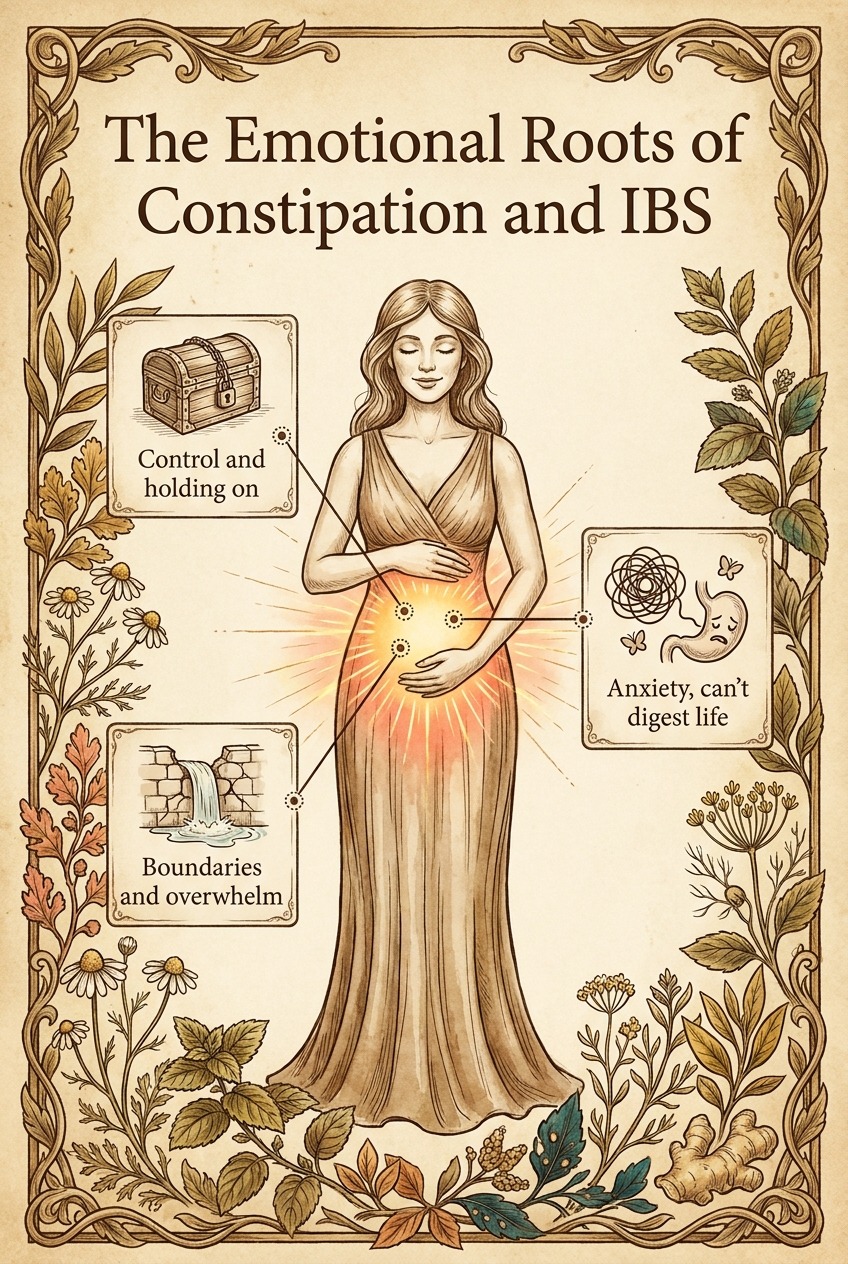
Constipation and IBS look like opposite problems. One grips and holds, the other rejects and runs. Emotionally they’re asking the same question from two directions: do I feel safe letting go? One answers by clamping down. The other answers by ejecting the thing before it can be taken in at all.
So this isn’t a checklist where you find your one box and stop. It’s a language. Two of the three below might sound like you, and that’s normal. Start with the one that named you and read that section first. The other two will still be here.
Which one is yours
One: control and holding on
This is the classic constipation pattern, and it’s the most common of the three.
The person who “can’t go” is very often the person who can’t loosen their grip anywhere. Not on outcomes, not on plans, not on being right, not on the past, not on the stuff in the garage they will absolutely never use. The traditions frame it as holding tight out of a felt scarcity: if I let go, I won’t have enough, or it will all fall apart, or I won’t be safe. So nothing gets released until it’s certain, and it’s never certain, so nothing gets released. The body just runs the same program the life is running.
Does this one fit?
- Do you struggle to delegate, throw things away, or leave things unresolved?
- When plans change on you without warning, does your body clench?
- Is “letting go” something you agree with in theory and almost never actually do?
- Do you over-buy, over-stock, and over-prepare, just in case?
If you read those and went “well, yes, obviously, doesn’t everyone,” that reflex is kind of the point.
Essences to know: Solomon’s Seal is the one for relinquishing control and the grip on outcomes, so you can work with the things that were never yours to steer. Prickly Pear is for the same grip when it shows up as over-buying and over-resourcing, the just-in-case hoarding underneath the holding. Cherry Plum is for the specific fear of what happens if you stop gritting through it and let go of the wheel.
Two: anxiety, safety, and “can’t digest life”
This is the IBS-and-urgency pattern, the gut that rejects an experience before it can assimilate it.
Where the first pattern grips, this one ejects. The body decides something isn’t safe and gets rid of it fast, sometimes before the mind has even named what the threat is. This is the on-alert nervous system: the worry loops, the catastrophizing, the digestive system that reacts to a stressful thing faster than you can think about it. The old body-decoding line for it is blunt: “I’ve swallowed something I don’t want to digest.” Chinese medicine puts the work of digesting experience under the element whose imbalance is worry and overthinking, the person who chews the same thought all day and cannot get it down.
Often there’s a situation, a relationship, or a room your body is trying to eject even while your mouth is out here saying it’s fine, it’s fine, everything’s fine.
Does this one fit?
- Does your gut react, with urgency or cramping or upset, before a stressful event your mind hasn’t even named yet?
- Do you replay conversations and worst-case scenarios on a loop?
- Is there a situation or a person your body seems to be trying to reject, even when you tell yourself everything is fine?
- Do you have trouble saying “no” or “enough,” so the pressure builds until something gives?
Essences to know: Blue Lupine is for exactly this, the worry loops that won’t quit and the nervous system stuck on high alert, when what it needs is a calmer baseline. Chamomile is the most literal one here, for stress that gets felt in the stomach as plain tummy tension. Red Chestnut is for the version where the worry is mostly about other people, the obsessive what-if thoughts that spin around someone you love.
Three: boundaries and overwhelm
This is the least expected one, and it’s the “irritable” take on an irritable gut.
Taken emotionally, an irritable bowel is a system that’s chronically irritated by its environment. Too much coming in, no filter, no boundary. The body-decoding tradition frames it as living at everyone else’s mercy, absorbing everything indiscriminately, in a permanent low state of anxiety about the volume. This is the empath who takes on the whole room’s stress, the person with no working “no,” the one drowning in more stimulation and obligation than any nervous system was built to sort. The body is trying to digest a quantity of “life” that was never yours to digest in the first place.
Chinese medicine gives the small intestine the job of discernment, separating what’s yours to keep from what is not. Without emotional boundaries, that sorting job becomes an inbox that never empties.
Does this one fit?
- Do you absorb other people’s moods and walk away drained?
- Is your gut at its worst when you are overstimulated, over-scheduled, or around too many people?
- Do you take on feelings and responsibilities that aren’t yours because saying no feels impossible?
- Does quiet, low-input time noticeably settle your digestion?
Essences to know: Yarrow Shield is the one for staying wide open without absorbing everyone else’s stress, anxiety, and bad moods, which is the whole story for the system that’s digesting a roomful of other people. It carries Dill for the sensory-overload half, when life is coming in faster than you can process it, and Rhubarb for casting off the negative energy you pick up from other people. One bottle covers this whole pattern.
If none of those was quite it
The three above cover most of it, but the digestive tract holds a few other things, and if your version isn’t named yet, look at what your gut is actually doing with the feeling. Is it holding it, rejecting it, or drowning in it?
A few of the adjacent patterns:
- Old bitterness that never got put down. The tradition describes colon trouble as knots of sorrow and anger that never got fully untied. If you’re holding a grudge, you’re often holding the intestines along with it. Willow is the essence for releasing bitterness and resentment and the victim-groove that keeps them fresh.
- Anger you swallowed instead of said. The old line is “I ate an indigestible comment.” Anger that had nowhere to go gets literally swallowed. Milk Thistle is the one for forgiving and letting go of anger, especially the long-running family kind.
- Grief that never moved. The letting-go organ stays jammed when there’s grief still standing in the hallway. Good Grief is the blend for grief that moves once the resistance to feeling it releases.
- Holding on long past when it helped. Onion is for when holding on to old pain has gone on too long and it’s genuinely time to let it move through.
If your particular spot still isn’t on this page, that’s fine, and it doesn’t mean the map forgot you. Ask what your gut is doing with the feeling. Gripping it, spitting it out, or trying to absorb more than it can hold. That’s your first clue, and it points you back to one of the three.
Where this fits
The gut is one region of a much bigger map. If you want the whole thing, the head loops, the throat words, the chest grief, the hips and everything else, it’s all in the full body map. People go in for one spot and come out an hour later, so consider yourself warned.
What to do with this
The map is the recognition, not the cure. None of this is a treatment for constipation or IBS, and a flower essence is not going to move your bowels. If your gut is genuinely struggling, that’s a conversation for you and your doctor, and it always was.
What an essence supports is the emotional posture the body is expressing. The grip, the rejection, the drowning. You’re not treating a bowel, you’re working on the letting-go, the safety, or the boundary that the bowel has been trying to talk to you about. When the posture eases, the body sometimes follows. That’s the whole claim, and it’s the only one worth making.
So find your pattern. Read the section that stopped you. People working on a letting-go pattern tend to start with Solomon’s Seal or Prickly Pear first. People whose digestive tract is running on anxiety more often start with Blue Lupine. And if your map came out tangled because half of what your gut is carrying isn’t yours, Yarrow Shield is the place to start, because there’s no point sorting an inbox that was never addressed to you.
Pick the one that named you, and start there. And if you read all three and still can’t tell which is yours, that’s exactly what a Custom Combo is for, a practitioner helps you sort it.
And if you want to work the physical side alongside the emotional, there’s a bioessence in the Secret Stash built for the gut and digestion, hertz frequencies paired with flower essences. It’s a members-only formulation, and it stays behind that door on purpose. If that’s a door you want open, that’s what the Vital Essence Association is.
Flower essences are not evaluated by the FDA and are not intended to diagnose, treat, cure, or prevent any disease. Nothing here is medical advice or a substitute for the care of your doctor.
Frequently Asked Questions
How long before I notice anything?
There’s no fixed timeline. Some people feel the grip start to ease within a couple of weeks of working with the right essence and being honest about what they’re holding; for others it’s slower. The emotional work matters more than the bottle, and it moves at the pace of what you’re willing to let go of.
Can a flower essence actually fix my constipation?
No. A flower essence isn’t going to move your bowels. What it supports is the emotional posture the digestive tract is expressing, the gripping or the rejecting or the drowning. If your gut is genuinely struggling, that’s a conversation for you and your doctor. This is the emotional layer underneath, not a treatment.
Do I need to know which of the three roots is mine first?
No. Read back through and notice which section stopped you. Ask what your gut is doing with the feeling: gripping it, spitting it out, or trying to absorb more than it can hold. That points you to one of the three. If you still can’t tell, a Custom Combo lets a practitioner build to your exact pattern.
What if my symptoms are severe or new?
Then see your doctor. New, severe, or changing digestive symptoms are a medical question first. The emotional-roots work is for the long-standing pattern underneath, not a substitute for getting checked.
Can I take an essence for this alongside my medication?
Essences work on the emotional and energetic level, so people commonly use them alongside their lives, but anything involving a medication or a diagnosed condition is your provider’s call. Keep your plan; the essence is for the emotional layer.
0 comments