

Somebody has to decide what to do with the chair.
Leave it where it is and everyone eats around the gap. Take it away and the table looks rearranged in a way everybody notices and nobody mentions. Give it to a cousin’s new boyfriend and now a man who’s met the family twice is sitting in Dad’s spot, asking for the rolls.
It can be the first holiday without someone or the tenth. The holidays are full of jobs, and every one of them used to belong to somebody. Who carves. Whose stuffing. Who calls at noon. Who falls asleep during the game and swears they didn’t.
Grief during the holidays gets specific that way. Each job uses a different part of you, and that’s usually where the grief shows up.
The short version: at the holidays, grief tends to collect in five places: the throat, the chest, the stomach, the shoulders and the jaw. Each has a flower essence that fits it, and most of them come together in one blend, Good Grief: Onion, Borage, Bleeding Heart and Chamomile, along with Star of Bethlehem for the numb stretch and Catalpa for older loss.
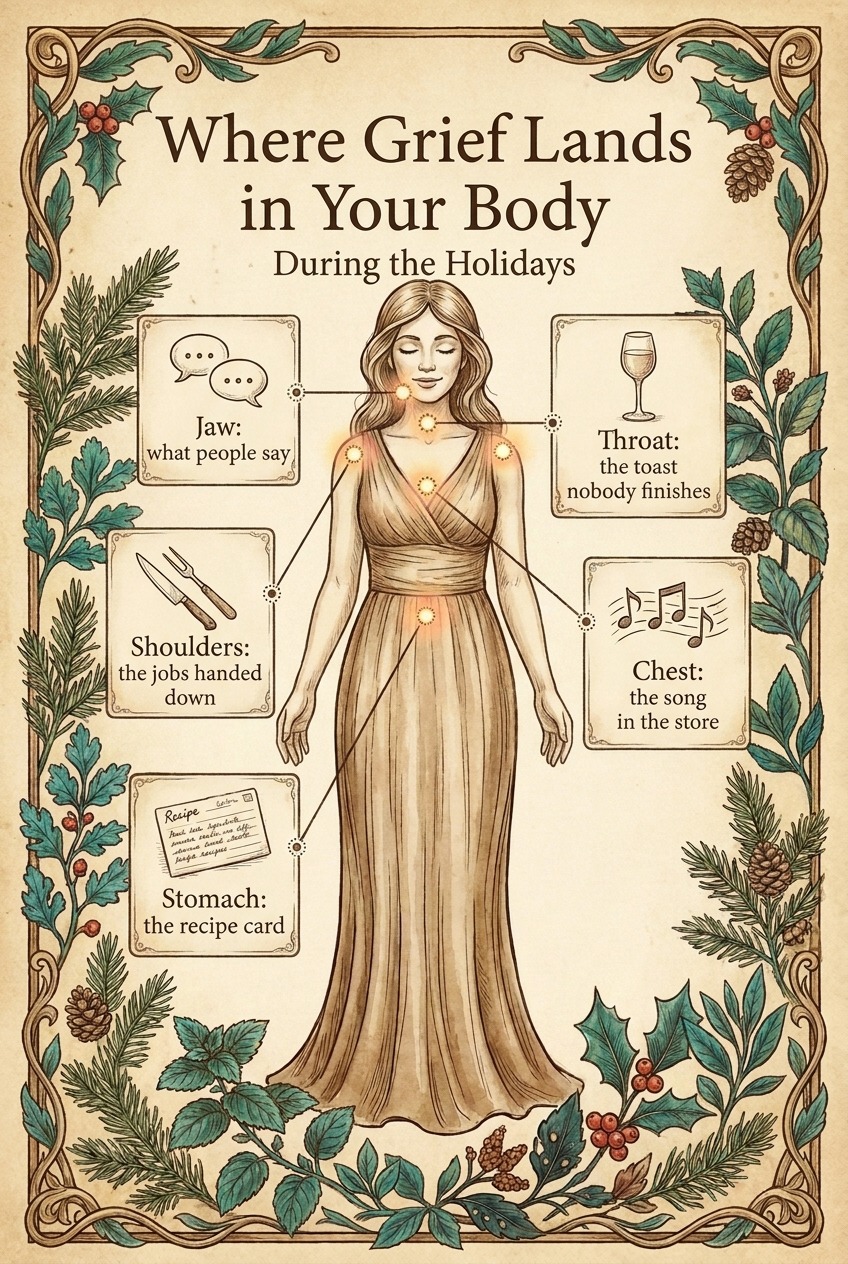
Grief can land lower, too. Your Hips Hold What You Never Grieved covers the kind that got interrupted and went to the hips. This post stays with the places it shows up at the table.
The throat: the toast nobody finishes
Somebody raises a glass and says the name, and the voice quits halfway through the sentence. Everyone looks at the mashed potatoes. Somebody’s uncle says “hear, hear” to fill the silence.
The throat is where the crying and the talking both have to pass. At the holidays it gets asked to do neither, or both at once in front of eleven relatives.
Onion is the flower essence that supports the grieving process in either direction. It can help emotions flow when tears feel stuck, and ease when tears won’t stop. You don’t have to figure out whether your response is “too much” or “not enough.” It helps you access your emotions, express them fully and let them move through, whether the grief is present or has been bottled up for years. Onion is in Good Grief.
The chest: the song in the grocery store
The store has been playing the same forty songs since Halloween. One of them was theirs. Now you’re standing in the baking aisle holding a can of pumpkin.
Grief’s classic home is the chest. It shows up as weight, as a gray heaviness that’s there through the shopping and the small talk and the drive home.
Borage is the flower essence for the heavy heart: the gray weight that settles on the chest and stays, the heaviness after a loss you can point to, and the discouragement that wears down your confidence so gradually you can’t say when the reserve ran out. It’s one of the flowers in Good Grief.
Not every empty chair has a death behind it. There’s the divorce, the family split, the grown child who stopped coming, the parent who’s alive and still not at the table. Nobody sends a card for those, and you’re still expected to pass the cranberry sauce.
Bleeding Heart is the flower essence for that grip. It’s for grief and painful attachment: the loss that started moving through and then locked, the person who’s gone from the table and still taking up room in your heart. It loosens the grip and leaves the heart open. Bleeding Heart is in Good Grief and in Heart Healer, the blend for heartbreak, abandonment and rejection.
The stomach: the recipe card
The recipe’s in their handwriting, with a butter stain on the corner and a step they never wrote down because they just knew it. The house smells exactly right. Then the plate arrives, and that’s the one dish you can’t get down.
Grief tends to land in the stomach, too.
Chamomile is the flower essence for stress felt in the stomach area. It’s a super soother, and much of the tension it eases is held in the stomach and solar plexus. It’s in Good Grief, where it’s part of what supports the natural grieving process and tender hearts.
The shoulders: the jobs that got handed down
The person who handled it all is gone, and the work didn’t leave with them. It went to whoever was standing closest. The cards. The pie. Calling the aunt who only talks to that one person. Getting everyone to the cemetery and back in time for dinner.
That’s a lot of carrying, and it comes with an audience. People admire it, which is nice, and it doesn’t leave a lot of room to put anything down.
Ocean Spray is the flower essence for grief carried beneath a calm exterior, for the strong one, the together one, the one everyone relies on. It supports allowing old grief to surface in waves while the strength stays put, and it offers a way to set some of it down without collapsing. It’s a single, not part of Good Grief, so it’s the one to look at when the carrying is the main thing.
The jaw: what people say about it
“She’s in a better place.” “At least you had all those years.” “It’s been a while now, hasn’t it?” Each one comes with a pat on the arm and usually a second helping.
They mean well. They really do. Nobody in that room is getting told what you’d like to say, so the jaw takes it, and by the drive home it’s made its opinion known.
Snapdragon is the flower essence for strong feeling that got blocked from open expression and settled in the jaw, the mouth and the throat. It redirects that energy without flattening the feeling.
Snapdragon is in Anger Management, the blend for old feeling that got pressed down and held for years. Its page puts Snapdragon’s part simply: every time you decided not to say the thing, your jaw learned the job.
When there’s nothing in any of those places
One more, because some people get to the table and feel almost nothing. The dishes get done. The arrangements got handled. The tears never showed up, and the relatives are starting to look at you funny about it.
Star of Bethlehem is the flower essence for the aftermath, the still and flat hours once the worst has passed, including what its page calls the frozen griever: the one who handled everything and never cried, because the part that would cry had already gone still. It helps soften the shut-down so feeling can come back at its own pace. It’s in Good Grief and in Aftershock, the blend for after any kind of trauma, old or new.
When the grief is bigger than this loss
And sometimes a loss opens an older one. The grief at the table can go back decades, to a door somebody walked out of.
Catalpa is the flower essence for abandonment, betrayal and the death of someone who was your safe place, especially when every new loss cracks open something much older. It’s in Good Grief and in Heart Healer.
Which blend fits
Good Grief is calming and soothing and facilitates a healthy grieving process. It’s a blend of six: Onion, Borage, Bleeding Heart, Chamomile, Star of Bethlehem and Catalpa. It covers grief that’s locked and grief that’s flooding, and it’s for a loss from last week or one you’ve been carrying for years. It doesn’t remove grief. You still grieve, and you still cry.
Heart Healer is for when the empty chair is about someone who left: heartbreak, abandonment, rejection, and fear of further hurt. It’s a blend of seven: Bleeding Heart, Catalpa, Chicory, Harebell, Malva, Oregon Grape and Sweet William.
Anger Management is for the jaw and every comment about your loss you swallowed at dinner. It’s a blend of seven: Plantain, Moonshine Yarrow, Sow Thistle, Snapdragon, Kerria, Milk Thistle and Sweet Cherry.
If there’s a lot more than grief going on in your holidays, Where Holiday Stress Shows Up in Your Body maps the rest of it, and Surviving Christmas has a flower essence for nearly every flavor of December.
The chair’s still the chair
Somebody’s still going to have to decide where it goes. Somebody’s still going to say the thing about the better place. The recipe still won’t taste quite right, because of that step nobody wrote down.
What grief does in the throat, the chest, the stomach, the shoulders and the jaw through all of that is the part these flower essences speak to.
New chest pain or trouble breathing is a doctor’s call, grief or no grief. If you’re experiencing severe grief, depression or thoughts of harming yourself, please reach out to a qualified healthcare professional.
Flower essences and bioessences support emotional and general well-being. They aren’t intended to diagnose, treat, cure or prevent any disease, and they don’t take the place of care from your healthcare provider. Statements here haven’t been evaluated by the FDA.
0 comments