

An underactive thyroid gets described in numbers, but nobody lives it in numbers. You live it as cold hands in a warm room. As hair in the drain and a heaviness that sleep doesn’t fix. As running a life at three-quarter speed while everyone around you seems to have a setting you don’t have. And underneath all of it, if you’re like a lot of people carrying this pattern, there’s a question that has less to do with your lab work than anyone has told you: whose pace is this, anyway?
Your thyroid is the gland that sets the speed of your life. That’s its literal job, the metabolic thermostat, deciding how much energy you’re allowed to spend and how warm you get to run. So when it slows down, the old body-wisdom traditions don’t ask “what’s wrong with the gland.” They ask what taught a body that it needed to slow down.
There are two very different answers to that question, and this post walks both, because one of them is emotional and one of them isn’t, and you may recognize yourself in either. Or both.
If you haven’t read the overview of thyroid patterns yet, that’s the wider map, four thyroid patterns and the buried stories under each. This is the deep-dive on the slow one. And one distinction before we start: if your slowdown comes with an autoimmune diagnosis, that’s Hashimoto’s, and it has its own post, because the self-attacking pattern is a different story than this one. This post is for the thyroid that’s simply running cold.
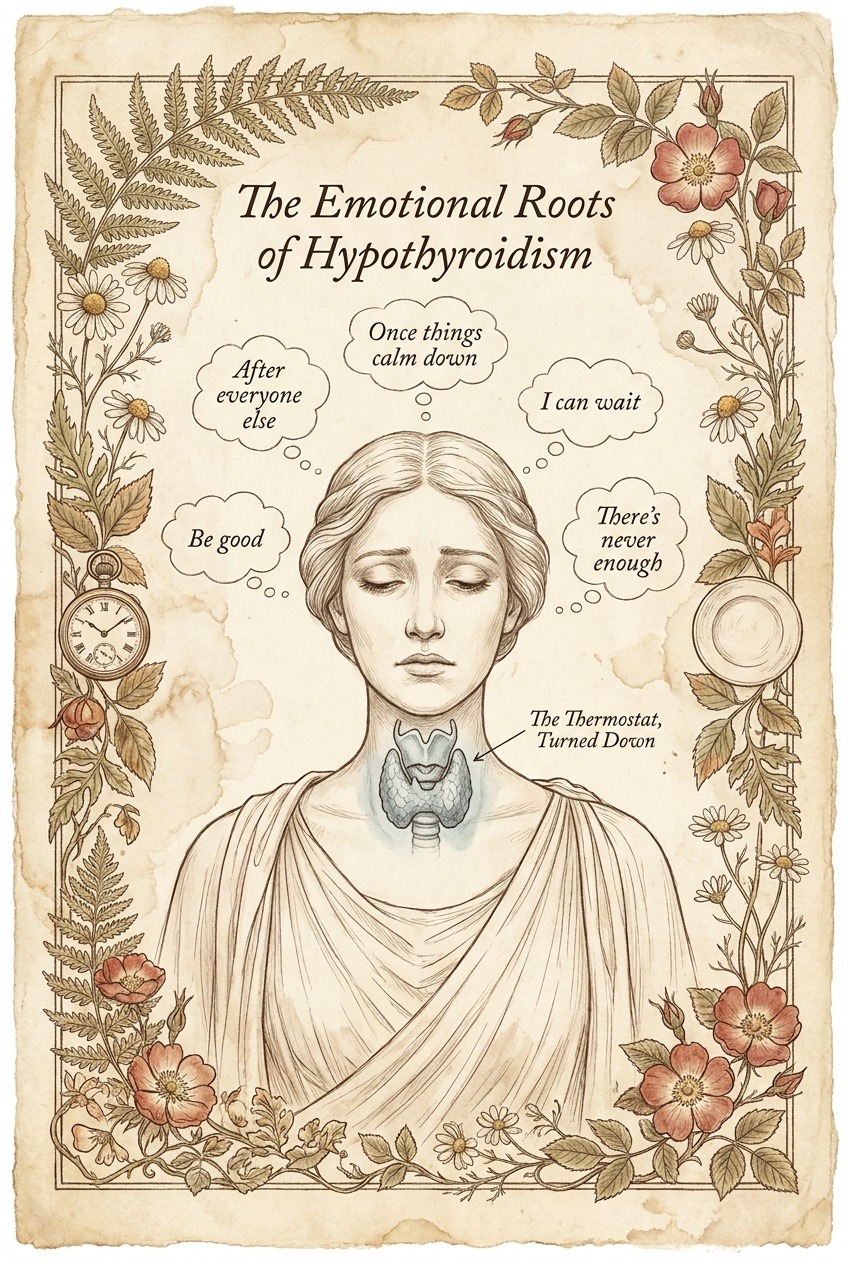
The first story: a life run on someone else’s clock
The German New Medicine tradition calls the thyroid the body’s biological clock, and frames its troubles as a conflict of time and powerlessness. Not fear, not grief. Time. I’m overtaken by events. I can’t keep the beat. When will it be my turn?
The slow version of that conflict looks like this. Somewhere along the way, the pace of your life stopped being yours. You got up when the household needed you up. You spent your energy where it was already spoken for before you woke. Your own projects, the ones that were supposed to happen “once things calm down,” have been waiting so long they’ve stopped tapping you on the shoulder. You’re not lazy, and you know it, though you may have quietly started to wonder. You’re a person whose accelerator belongs to other people, and whose turn keeps not coming.
A body can hold that for a long time. But the traditions that call the thyroid the clock-keeper say that eventually the body stops fighting the arithmetic. If your energy is never going to be spent on your own life, why produce so much of it? The thermostat comes down. The brake goes on. Not as a malfunction. As a kind of grim bookkeeping.
Many people who live inside this pattern describe it in nearly the same words:
- I’m always waiting until everyone else is taken care of.
- I can’t remember the last time the schedule was mine.
- I’m not tired from doing too much. I’m tired from never doing my own things.
- When is it going to be my turn?
That last sentence turns up, word for word, in two traditions that never talked to each other. The overview covers why that convergence matters. Here it’s enough to say: if that’s the sentence running under your life, your thyroid is the gland that’s been keeping the ledger.
The second story: the thermostat you turned down yourself
This one isn’t a buried feeling, and I’m not going to dress it up as one.
Decades of dieting. Caloric restriction, the low-carb years, the no-carb years, “being good,” skipping meals, earning your food. Your thyroid reads sustained under-eating as famine, and it responds exactly the way it was built to: it slows the thermostat to conserve energy. Prolonged restriction reliably drops your active thyroid hormone, and it’s the carbohydrate cut specifically that does most of it, not calories alone. The deeper the restriction, the bigger the drop. Do that for twenty or thirty years, on and off, and you’ve been asking your thyroid to run cold over and over, and calling it discipline every time.
Two things have to be said together here, and both are true. First: this is an adaptation, not a malfunction. It’s your body being smart about scarcity, and it isn’t proof that dieting gave you a disease. Second: it’s very likely the single most common thyroid-relevant thing the people reading this have done, and almost nobody connects it to their thyroid, because the whole time it was happening, it was being praised.
And the reason it belongs on a page about emotional roots is that the restriction was never really about food. Nobody diets for thirty years out of hunger management. The engine underneath was body shame, worth measured in pounds, control of the one controllable thing, and a culture that trained a generation of women to treat their own bodies as a problem to manage. That’s the root. The famine response is just your thyroid taking the whole thing seriously.
Notice, too, that the two stories on this page are cousins. Overriding your body’s hunger for decades and overriding your own pace for decades are the same move performed on different material: what you need, postponed indefinitely, in favor of what’s expected of you.
Where this comes from
The clock-and-pace thread comes out of German New Medicine, which puts the thyroid squarely on time, urgency, and powerlessness, and casts the underactive side as the brake: the piece of life you can’t get moving. Louise Hay’s thyroid entry circles the same ground from another direction, humiliation and “I never get to do what I want to do.” The throat-center tradition adds the location: the gland sits in the channel where your truth either comes out or gets swallowed, so a slowed thyroid tends to keep company with a swallowed voice. Several unattached maps, same neighborhood.
The famine response is different. That one isn’t tradition at all, it’s mainstream physiology, measured and repeatable. Which makes this post an unusual pairing: one thread carried by the old traditions, one carried by endocrinology, and both of them describing a body that learned there wasn’t enough, of time or of food, and adjusted accordingly.
This is the level underneath the labs, the one the bloodwork can’t see.
What the slowdown might be saying
If the pattern could put itself into words, I think it would sound like this:
You’ve been telling me for years that there isn’t enough. Not enough time for your own life, not enough food for your own body, not enough turn to go around. I believed you. I slowed everything down so we could survive the shortage. If you want me to warm back up, stop rationing. Feed me like there’s enough food. Spend energy on your own life like there’s enough time. I’ll take the news that the famine is over from your behavior, not from your intentions.
That’s the reframe worth keeping: a slow thyroid, seen this way, isn’t a body failing you. It’s a body cooperating with instructions you didn’t know you were giving.
If this isn’t you
Real information, not a failure of the idea. The thyroid takes a few different shapes, and the slow non-autoimmune one is only one of them. Quick routing:
- If your slowdown comes with antibodies and an autoimmune diagnosis, read the Hashimoto’s post. The self-attack pattern has its own story, and it deserves the full version.
- Racing rather than slowing, wired, hot, unable to rest? That’s the other pedal entirely: the hyperthyroid and Graves’ post covers the accelerator.
- If the thing you notice is a lump or swelling in your throat, that’s the structural version, nodules and goiter, the swallowed thing made visible.
- And if none of the threads on any of these pages lands, the whole-body map is the wider view.
What warms a cold pattern back up
Not more discipline. This pattern was built out of discipline, and one more program is just the old instruction in a new binder. What tends to move it looks smaller and more subversive than that:
- Put one thing that’s yours back on the calendar, at full priority. Not squeezed into the margins after everyone’s fed. An actual claim on actual time. The point is the message: my turn exists.
- Eat like the famine is over. For the dieting-history reader this is the whole work, and it’s harder than any restriction ever was. Enough food, carbohydrates included, on purpose, without earning it first. If a truce with food feels impossible alone, that’s what support is for. But the direction is feeding, not managing.
- Let the people around you absorb a delay. Every time someone else’s urgency automatically outranks your pace, the clock-conflict runs another lap. They’ll survive the wait. That’s information your body needs, delivered live.
- Grieve the years the turn didn’t come. There’s real loss in a life spent on other people’s clocks, and swallowing that loss one more time is just the pattern again. It’s allowed to be sad. Sad moves. Swallowed stays.
Where flower essences come in
Flower essences work on the emotional side of all this, which is the side this whole post lives on. They aren’t a treatment for your thyroid or your hormone levels, and I’d rather lose a sale than have you hear it that way. What they support is the pattern underneath: the postponed turn, the body shame, the depleted years.
For the famine story
Start with the root rather than the food. Pretty Face is for feeling “less than” about your body, the worth-tied-to-appearance wound the whole restriction era was built on. Alongside it, Craving Control, and I want to be precise about why, because the name points the wrong way for you: control isn’t what you need more of. The reason it earns a place here is the other half of what it does, tuning you in to what your body actually needs and mending your relationship with food. That’s the truce. Take it for that or skip it.
For the clock story, and the depletion it left
Self-Heal puts you back in charge of your own recovery and tunes you to what you personally need, never mind the gurus, which for a person whose pace has always been assigned is the foundational move. Harebell works the you-are-good-enough-as-you-are ground, for the one who keeps giving their power away to stay welcome. And Missouri Primrose is for the guilt and unworthiness that make it hard to receive anything good, including a turn, when one is finally offered.
And for the sheer depletion, Teasel is made for the emotionally exhausted, the energy lost through long strain and challenging relationships, with a side of encouraging you toward work and a life that actually restore you instead of draining you.
Pick one that fits. The essence keeps the emotional work company.
For members who go deeper, there’s a bioessence in the Secret Stash built around this same emotional-roots-of-the-throat territory, combining flower essences with hertz frequencies. It’s a members-only formulation, and it stays behind that door on purpose. If that’s a door you want open, that’s what the Vital Essence Association is.
Flower essences are not evaluated by the FDA and are not intended to diagnose, treat, cure, or prevent any disease. Nothing here is medical advice or a substitute for the care of your doctor.
What to do with this
Find which of the two stories made something in you go still, the assigned pace or the long famine, and start there. If it’s the pace, put one claim on your own time this week and let somebody wait. If it’s the famine, the work is feeding, not managing. And since the thing that made feeding feel forbidden was never hunger but body shame, Pretty Face is where I’d point first. If both landed, they usually travel together, and a Custom Combo lets a practitioner build to your exact pattern instead of you guessing.
Your thyroid has spent years believing there wasn’t enough. The work, on the emotional side, is delivering the other news. The wider map of the thyroid’s patterns is in the overview, and the siblings of this post cover Hashimoto’s, hyperthyroid and Graves’, and nodules and goiter.
Frequently Asked Questions
Is this the same as Hashimoto’s?
No. Hashimoto’s is the autoimmune version, where the immune system attacks the thyroid, and it has its own post with its own pattern, the self-attacking one. This post is about the non-autoimmune slow thyroid, the one that’s simply running cold.
Can dieting really slow a thyroid down?
Prolonged under-eating reliably lowers active thyroid hormone, and it’s the carbohydrate cut specifically that does most of it. It’s an adaptation, your body conserving energy through what it takes for famine, not a disease you gave yourself. The direction that helps is feeding, not managing, and the medical side of it belongs with your provider.
Can I take a flower essence alongside my thyroid medication?
Flower essences work on the emotional and energetic level, not the biochemical one, so people commonly use them alongside everyday life. But anything involving a diagnosed condition or a medication is a conversation for your prescribing provider. Keep taking what your doctor prescribed; the essence is for the layer underneath.
Do I have to figure out which of the two stories is mine?
No. They usually travel together, since overriding your own pace and overriding your own hunger are the same move on different material. Start with whichever one made something in you go still, and if you genuinely can’t tell, a Custom Combo lets a practitioner build to your exact pattern.
How long before I notice anything?
There’s no clock on this. The pattern is usually decades old, and the essence keeps the emotional work company rather than doing it for you. Some people feel a shift within a few weeks of claiming real time and eating like the famine is over; for others it’s slower.
0 comments