

Have you ever been absolutely certain about something, only to find out later that you had the whole thing wrong?
Yeah. Me too.
And the worst part is that while you were busy being wrong, all those feelings you were having were perfectly real.
The anger. The rejection. The anxiety. The sense of betrayal.
You might have spent days stewing over something that wasn’t even happening the way you thought it was.
Or maybe you were right all along.
That’s what makes this so interesting.
I’ve said for years that when you’re choosing flower essences, it doesn’t necessarily matter whether your perception of a situation is accurate. You can choose essences based on how you feel about it, because that’s the emotional experience you’re having.
I still stand by that.
But I’ve been thinking about where that advice needs a little more explanation. Because while your feelings are real, the conclusions you draw from them aren’t necessarily accurate.
And sometimes that distinction matters. A LOT.
Your brain is not a security camera
We like to think we remember what happened.
We saw it. We heard it. We were THERE, for crying out loud.
But memory is a funny thing.
We don’t take in everything happening around us. We notice certain details, miss others, interpret what we’re seeing through our existing beliefs, and then store our own version of the experience.
Later, when we remember it, we’re reconstructing that experience. And our emotions can influence that reconstruction, too.
Two people can walk away from the same conversation with entirely different accounts of what happened.
Neither one necessarily has to be lying.
One remembers being criticized. The other remembers offering a helpful suggestion.
One remembers someone being angry. The other remembers being tired and distracted.
And both can be absolutely convinced they’re remembering it correctly.
So even when we say, “Let’s look at the facts,” we’re often looking at our recollection of the facts.
Which may or may not be particularly accurate.
Fun, huh?
Sometimes you’re reacting to something that happened 20 years ago
Here’s where old emotional wounds really complicate things.
Let’s say you grew up with a parent whose moods were unpredictable.
You learned to pay close attention to facial expressions, tone of voice, how someone walked into a room, whether they were talking more or less than usual.
You got pretty good at reading the room because you needed to.
Now you’re an adult.
Your spouse comes home from work and seems withdrawn. Doesn’t say much. Maybe answers a question a little abruptly.
And suddenly you’re anxious.
What’s wrong? Are they mad at me? What did I do?
Meanwhile, your spouse had a lousy day at work and just wants to sit down for half an hour.
You may have accurately noticed that something was off. Your instincts picked up on a change.
But the meaning you attached to it came from a much older experience.
This is one of the things that makes emotional work so fascinating. We’re not always responding to what’s happening right now. Sometimes we’re responding to what the present reminds us of.
And sometimes it’s both.
Your spouse might genuinely be irritable. You might also be responding with the emotional intensity you experienced as a child.
There’s no rule that says only one thing can be happening at a time.
What about intuition?
Now, I don’t want you to take all this as an invitation to second-guess every instinct you have.
Especially when it comes to your safety.
If someone makes you uncomfortable, pay attention.
If a situation feels unsafe, take reasonable precautions.
You do not owe anyone access to you while you figure out whether your instincts are correct.
Sometimes we pick up on subtle patterns in people’s behavior before we’ve consciously identified what’s bothering us.
Other times, something about a person or situation reminds us of a previous experience, and our internal alarms start going off.
Those experiences can feel remarkably similar.
And you may not know which one you’re dealing with.
That’s okay.
You can maintain your boundaries, keep your distance, gather more information, or leave a situation without first proving that your concerns are justified.
I would much rather someone err on the side of protecting themselves than talk themselves out of a legitimate warning because they couldn’t explain it.
But once you’re in a position to examine what’s going on, it’s worth asking whether your emotional history might be influencing your interpretation.
Your instincts deserve your attention. Your interpretations deserve examination.
Both can be true.
When your version of the story becomes the problem
Here’s another interesting wrinkle.
Once we decide something is true, we tend to notice everything that supports that conclusion.
And we can become remarkably creative about explaining away anything that doesn’t.
If you’ve decided someone doesn’t like you, every missed phone call, distracted conversation, or awkward facial expression becomes more evidence.
If they do something nice?
Well, maybe they’re just being fake.
See how that works?
You’ve constructed an explanation that can accommodate absolutely anything.
This is called confirmation bias, and we’re all susceptible to it.
The problem is that we can become so invested in our understanding of a situation that we stop being curious about what else might be going on.
And if that interpretation is rooted in an old emotional wound, it can become a self-perpetuating mess.
You expect rejection.
You interpret ambiguous behavior as rejection.
You respond defensively, withdraw, or become demanding.
The relationship becomes strained.
And now you have even more evidence that people reject you.
Lovely little arrangement, isn’t it?
This is one reason I think it’s worthwhile to work on the emotional patterns themselves.
Because when you’re carrying around a strong expectation of rejection, betrayal, criticism, or abandonment, it can influence what you notice, how you interpret it, and how you respond.
And sometimes our own responses help create the very circumstances we’re afraid of.
I’ll throw myself under the bus here
I recently had a pretty good example of all this playing out in my own life.
There’s another business owner whose Facebook posts I follow, and I’d been finding myself increasingly irritated by the way she responded to criticism and unpleasant interactions with people.
Now, ordinarily, I might roll my eyes at something like that and go about my day.
People are going to people. You can’t get worked up over every little thing.
But this was bothering me WAY more than it should have.
Which got my attention.
So I posted about it on Facebook, partly because I wanted to figure out what the heck was going on with me.
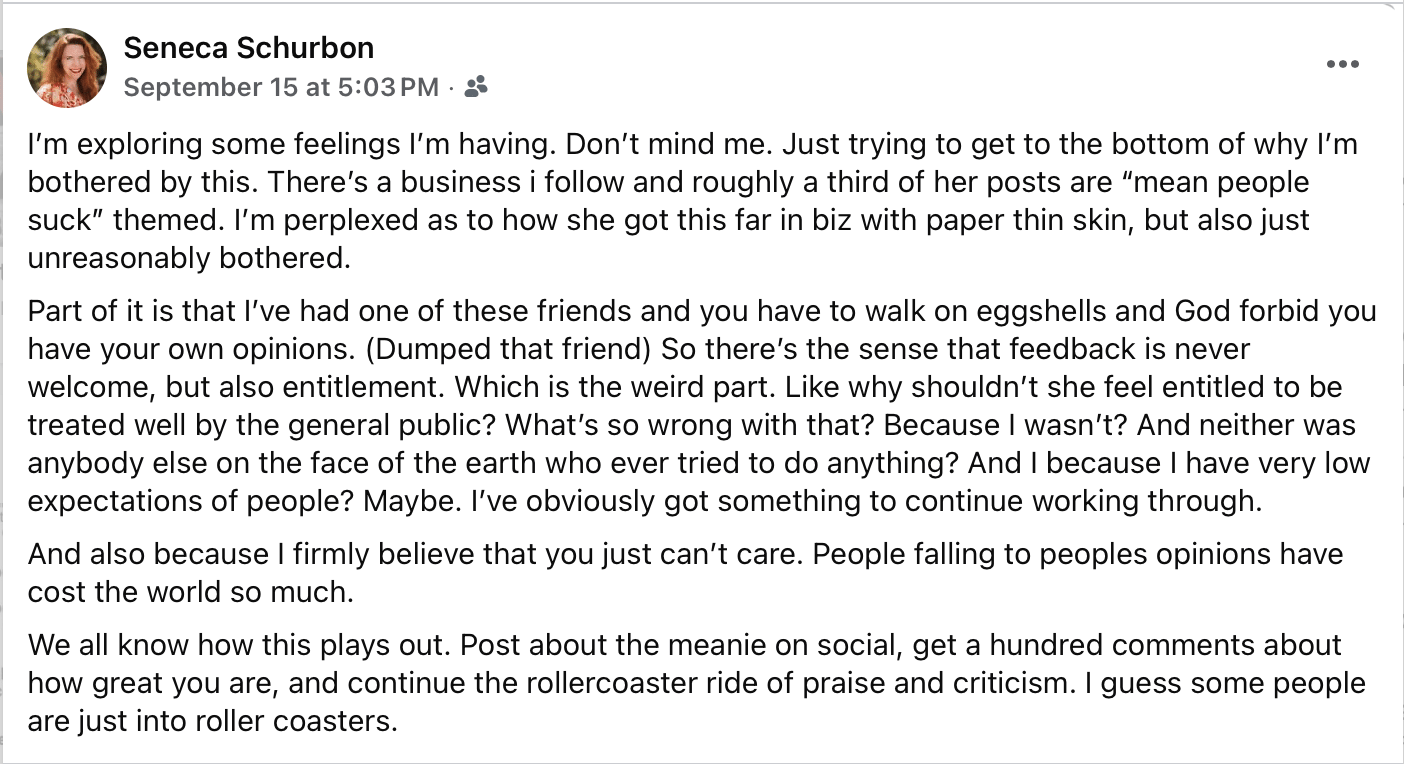
Look at me, being all compassionate and emotionally evolved. 😂
I had some pretty unflattering judgments about this woman.
Paper-thin skin. Entitlement. Needing constant reassurance.
Apparently, I had appointed myself the official judge of how much criticism another business owner should be able to tolerate.
And the more I thought about it, the more ridiculous my reaction seemed.
Why was I so bothered by this woman’s expectation that people should treat her nicely?
I mean, why SHOULDN’T they?
Is that really too much to ask?
Somewhere along the way, I’d developed an expectation that people generally aren’t going to be particularly kind, supportive, or understanding.
I’m on my own out here. I can handle it.
I’ve learned to let minor unpleasant interactions roll off and get on with my life.
And apparently, I was a little offended by someone who hadn’t gotten that memo.
Well, that’s interesting.
Then my Facebook commenters introduced another possibility I hadn’t even considered.
She might have been posting comment-bait.
You know, the kind of posts that get people rushing into the comments with reassurance and encouragement, which Facebook happily rewards with more visibility.
Oh.
So while she was potentially just getting engagement for her business, I was over here conducting a full psychological evaluation of someone I don’t even know.
Excellent work, Seneca.
Now, I still don’t know what was going on with her.
Maybe she genuinely was upset. Maybe she was deliberately encouraging engagement. Maybe both.
But my reaction had uncovered an old association and a few assumptions of my own that deserved another look.
I didn’t have to establish what was true about her to learn something about myself.
And that’s the whole point.
Three questions worth asking yourself
I have a question I regularly ask myself when my emotional response seems out of proportion to the circumstances.
Actually, there are three questions worth considering, and my little Facebook adventure is a pretty good illustration of all of them.
1. Does this feeling seem bigger than the situation warrants?
I use this one a LOT.
Because I’ve learned that when my reaction seems disproportionately large, there’s a pretty good chance something else is involved.
Maybe an old wound has been poked.
Maybe this is the fifth time something similar has happened, and I’m responding to the accumulation rather than this one incident.
Or maybe the situation really IS that serious.
That’s worth considering, too.
I don’t automatically assume I’m overreacting just because I’m having a strong emotional response.
But when something relatively minor sends me into an emotional tailspin, I’m curious about why.
Why did THAT particular comment get under my skin?
There’s usually something interesting to find if I’m willing to look.
And sometimes it’s something I’d rather not find.
2. Is this a familiar reaction?
Have you felt this way before?
Do you keep experiencing the same conflict with different people?
Maybe every boss you’ve ever had makes you feel inadequate.
Maybe you consistently feel excluded in friendships.
Maybe you enter relationships expecting to be abandoned.
If the same emotional experience keeps showing up in different circumstances, it’s worth looking for a common thread.
That doesn’t mean everyone else is innocent of wrongdoing.
But it does suggest there’s something recurring in your experience that deserves attention.
In my case, recognizing that this woman’s behavior reminded me of a former friend gave me a clue about why I was responding so strongly.
It didn’t explain everything, but it was a start.
3. What evidence would change my mind?
Oooo. This one can be uncomfortable.
If you’ve concluded that somebody dislikes you, what could they do that would cause you to reconsider?
If you believe you’re incompetent, what would count as evidence that you’re actually capable?
If you’re certain someone has bad intentions, is there any realistic explanation for their behavior that you’d be willing to entertain?
You don’t have to change your mind.
But if you can’t imagine ANYTHING that would cause you to reconsider, you might be more attached to your interpretation than you realize.
In my Facebook example, other people suggested an explanation I hadn’t considered.
Was it the correct explanation? Who knows?
But it was enough to get me considering some other possibilities instead of remaining convinced that I’d figured this woman out.
And that was useful.
When you don’t know which way is up
I’ve always recommended working with a practitioner when you get so tangled up in a situation that you genuinely can’t tell what’s going on anymore.
Sometimes you’re dealing with several layers of emotional stuff at once.
Maybe you’re picking up on a legitimate problem in a relationship, but your own history is amplifying your response.
Maybe you’re so accustomed to being mistreated that you’ve started accepting things you shouldn’t.
Or maybe you’ve spent years anticipating rejection, and now you struggle to recognize when somebody actually cares about you.
It can be very difficult to see your own patterns when you’re living inside them.
An outside perspective can be enormously valuable.
If you’d like a place to start untangling on your own, Flora is a bot I trained to do exactly that. She’ll listen, reflect patterns back to you, and keep pulling on the threads until you can see what’s actually underneath.
Our flower essence practitioner is also a qualified mental health professional, which is particularly helpful when someone needs assistance sorting through their perceptions, emotional history, and present circumstances.
Sometimes the first order of business is simply figuring out which issue deserves your attention.
And if you’re experiencing serious confusion about what’s real, overwhelming fear, or difficulty functioning in everyday life, that’s an especially important time to get the right support, including a doctor or therapist near you.
You don’t have to figure everything out by yourself.
So how do you choose flower essences when you’re not sure what’s true?
Here’s where I want to circle back to something I’ve been saying for years.
You can absolutely choose flower essences based on what’s true for you, even if your interpretation of the situation turns out to be wrong.
If you feel rejected, that’s the emotional experience you’re having.
You don’t need to prove somebody rejected you before choosing an essence that addresses feelings of rejection.
If you’re carrying resentment because you believe somebody wronged you, you can work on that resentment without settling the question of who was right.
If you feel fearful, defensive, insecure, or overwhelmed, those are all emotional states you can use as starting points for choosing essences.
You don’t have to know exactly where the feelings came from, either.
And there’s a good reason I encourage people to approach essence selection this way.
When you’re in the middle of an emotionally charged situation, it’s awfully difficult to see things objectively.
You’re viewing everything through the lens of whatever you’re feeling, along with the beliefs and experiences you’ve accumulated over a lifetime.
In my experience, one of the most valuable aspects of working with flower essences is the opportunity to work on those underlying emotional patterns.
And as that emotional charge begins to settle, you may find that your perspective changes.
Maybe you were right all along.
Maybe you misunderstood the situation completely.
Maybe someone really did behave badly, but your reaction was intensified by something from your past.
Or maybe you discover that you’ve been interpreting perfectly ordinary interactions through the lens of an old rejection or betrayal.
You might even realize that the person you’ve been blaming for your distress had very little to do with where the feeling originated.
That can be quite a revelation.
Of course, feeling calmer doesn’t automatically mean you’ve arrived at the truth. You still need to pay attention to what’s happening, remain open to new information, and sometimes get another perspective.
But when your emotions are no longer running the entire show, it may be much easier to recognize what’s valid about your original perception and what was being colored by old experiences.
You might find that you need to establish firmer boundaries.
You might discover that there’s nothing to be afraid of.
Or you might realize that the current situation needs attention AND there’s an older emotional pattern you’d benefit from working through.
That’s progress, regardless of which conclusion you reach.
You don’t have to get the entire story right before you can start working on your part of it.
And you don’t have to dismiss your instincts or abandon your boundaries while you’re doing that work.
You can start with the feelings you’re aware of today, even if you don’t completely understand them.
As those emotional patterns shift, you may become better able to recognize what’s happening in front of you, without carrying quite so much of yesterday into it.
Which, when you think about it, is a pretty good reason to work on those old wounds in the first place.
These statements have not been evaluated by the Food and Drug Administration. This content is not intended to diagnose, treat, cure, or prevent any disease.
0 comments